
Audience personas are foundational for human-centered comms, but creating them can take months. Learn how to use AI collaboration to accelerate audience research while capturing authentic insights from real conversations.
Audience personas are one of the most valuable tools in strategic communications. Personas capture key insights about the people we seek to reach, helping us empathize with our audience members and create compelling content. But producing useful personas is notoriously difficult.
When I worked with USAID, the process could drag on for months — or get stopped in its tracks entirely. First, we needed to get buy-in from multiple layers of approvers: program managers, contract representatives, regional bureaus or missions, etc. Then came the logistics of coordinating interviews, adding more layers of approvals and the persistent challenge of scheduling calls with busy people across multiple time zones. Often, by the time we collected data from interviews and synthesized insights, the original strategic objective had evolved and the window of opportunity closed.
In contrast, last week I developed a set of draft personas for a client in a matter of hours.
I’m working with a client to help understand his target market before he builds a new website for his coaching business. Working in Centaur Mode — my approach to human-AI collaboration — I adapted my typical approach to persona development. In the time it would take to schedule an approval meeting, we had a set of functional personas ready for validation through interviews.
The accelerated Centaur workflow
The approach I would typically take to develop personas would look something like this: get buy-in from key stakeholders, plan and coordinate interviews, synthesize interviews, and develop personas documents. We can still follow this approach, leveraging AI tools to streamline each step.
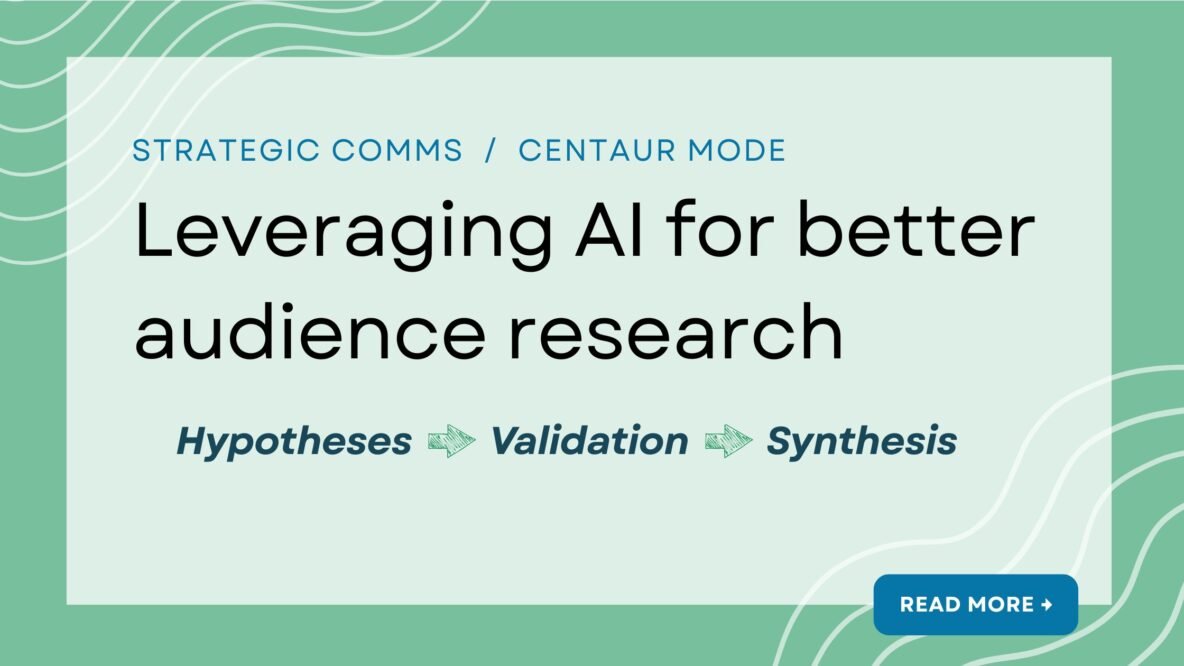
However, there’s a faster approach that flips the sequence: start with hypotheses and then validate them through conversations. Having an actual persona document in hand makes it a lot easier for your stakeholders to see the value and potential applications of personas.
Here’s how it works in practice:
Brainstorm personas
Rather than starting from scratch, I work with Claude to rapidly generate initial persona segments based on what I (or my client) already know about the market.
For my coaching client, we started by identifying his primary audience segments. He works almost exclusively with mission-driven executives. Through a brief discussion, we clarified the most common coaching scenarios for these leaders. These formed the basis for three personas. For each segment, we brainstormed preliminary insights across the key persona categories: their values, daily tasks, pain points, and desired gains (see my previous article on creating personas for more info on this approach). Many of these came from the client’s experience working with people in each persona category.
With these initial insights, I brought our notes and draft ideas into Claude. I have added some guidelines, templates, and examples to a Claude project to help it shape the outputs according to my preferences.
Within an hour, we had three audience personas that represent our best guesses for what matters to each group — guesses that we could later validate through interviews.
Which points to a key insight: This stage is all about articulating hypotheses. Having concrete examples makes it much easier to get buy-in for further research — or to start creating messages to test with your audience.
Get buy-in with examples in hand
This stage is where the accelerated approach really shines. Instead of asking stakeholders to approve a vague research plan, you can show them draft personas and say, “Here’s what we think we know. Let’s talk to people and find out what we’re missing.”
In large organizations, this can dramatically shorten approval cycles. It’s a lot easier for someone to see the potential value and application of a persona when it’s a concrete document.
Validate through interviews
Now comes the human work that can’t be delegated: actual conversations with real people. This is where you discover which of your hypotheses hold up and which need to be thrown out or adapted.
I use the same foundational principles I’ve always used for audience interviews: meet people where they are, progress from general to specific questions, capture insights in their own words, and listen with an open mind. But here’s what changes: because you’ve already done the initial brainstorming, you can listen for surprises. As you listen deeply to their experiences, you get a sense of whether your initial persona draft reflects their experience or misses the mark entirely.
Synthesize with AI support
After interviews, I work with Claude to process transcripts and update the initial persona documents. This is perhaps where AI provides the most value. I can feed in dozens of pages of interview transcripts and notes and ask Claude to pull out specific insights, identify patterns across multiple conversations, or flag where interview findings contradict our initial assumptions.
I might ask: “Based on these three interviews, what are the consistent pain points that came up?” or “How do these findings differ from our initial persona draft for mission-driven executives?”
This back-and-forth uses both human and AI capabilities well: I guide the process and assess the big picture of how the various insights fit together, while AI handles the tedious work and heavy lifting of reviewing lengthy transcripts. I’m making the strategic calls about what matters, what to emphasize, and how to organize insights. Claude is functioning as a research assistant with (mostly) perfect recall and infinite patience.
Update and refine
The final step is updating the persona documents with validated insights. Some sections of your initial draft might need only minor tweaks. Others might require complete rewrites based on what you learned. And you might discover you need to split a segment into two distinct personas or merge others that turned out to be more similar than you thought.
A practical tip: create a single, ongoing chat in Claude that contains the full process from initial brainstorming through synthesis. This way, Claude can refer back to the original personas and export an updated version reflecting the interview insights.
Your personas will only grow more useful over time. The more audience members you speak to, the better the personas capture practical insights that will help you connect more authentically with your audience.
Integrate into your workflow
The final step is making these personas actually usable. I add them to my project knowledge in Claude so that every time I’m drafting website copy, developing messaging, or planning a content strategy, the personas are there informing the work. They become a living resource, not a static document. They are far less likely to sit on a virtual shelf collecting digital dust.
Three principles for success
After working this way across multiple projects, I’ve identified a few principles that make the difference between personas that gather dust and personas that actually drive better comms:
Iterate and validate
Just as in human-centered design, a successful process typically involves a rapid cycle of iteration: conduct research, develop prototypes, test with real people, and refine. Back through the cycle until your prototype is ready for prime time.
Likewise, we can apply this principle to create valuable personas. AI tools can help us brainstorm initial insights, so that we have something to test. But there’s no substitute for talking to real people. Every conversation reveals something you didn’t expect, some nuance you couldn’t have anticipated. With each interview, we can refine our prototype personas until they better reflect the reality our audience members face.
Outline your process in advance
Following a clear sequence of stages like the one above makes it far more likely you’ll develop usable materials. Without a plan, it’s easy to get lost in the back-and-forth with AI or to skip crucial validation steps. Decide upfront how many interviews you’ll conduct, what questions you’ll ask, and how you’ll synthesize findings. See the workflow resource linked below for a concise summary of how to structure the human-AI collaboration process for developing personas.
Build your insight library
With every brainstorming session, conversation, and iteration, you’re gathering valuable information about your audiences. Over time, this creates a collection of practical insights that informs not just personas but your entire communications approach. Save transcripts, document patterns, track how your understanding evolves.
The value compounds over time — each insight builds on the last. Your insight library will become a force multiplier, capturing knowledge specific to your work that can be applied across various domains.
Get started
The traditional approach to audience research is thorough but slow. The accelerated Centaur Mode approach is fast but also rigorous, starting with informed hypotheses that you validate and refine through real conversations.
This accelerated approach helps you reduce the admin overhead that makes persona development feel like a chore. And it gives you space to do more of what actually matters: connecting with people. You can gain a deeper understanding of your audience in days, not months — so you can spend more time creating comms that resonate.
Ready to try this approach on your next project? Download my Centaur Mode audience research workflow guide, which includes both the accelerated approach described above and a standard workflow showing where AI can help at each traditional stage. You can also access my audience interview question guide and a user persona document template to get you started.