
Unite your team around strategic communications priorities through collaborative brainstorming and AI-accelerated refinement, prioritization, and implementation planning.
They hired me to create a communication strategy. But from the very beginning, it was clear that implementing a strategy would be an uphill battle. Every action was opportunistic — based on whim, not strategic direction.
The comms team lived in a persistent state of stress, like treading water with weights around your ankles. The daily requests for “can you make this beautiful” meant the team spent every working minute treading even faster, but never able to get anywhere. Since every request had very little connection to other activities, the public-facing result was a mess of disconnected stories and “here’s some stuff we did.”
This scenario is all too common in nonprofits. Constrained budgets, big ambitions, and staff stretched to their limits to achieve more with less all conspire to keep teams underwater.
But it doesn’t have to be this way.
It’s easier than ever to create a communications roadmap that unites teams towards cohesive action that achieves our organizational goals. Here’s a co-creation workflow that includes key internal stakeholders and leverages Centaur Mode — close collaboration between humans and AI — to rapidly refine, pressure test, and prioritize proposed goals and activities. This process combines traditional strategic planning with AI acceleration. You’ll learn both a comms roadmapping framework and how to use AI as a thought partner.
Phase one: Brainstorm
- Time required: 45 to 60 minutes
- Who’s involved: Humans, ideally members of the leadership team and key comms contributors
We kick off the process with only humans in the room, with some good old-fashioned brainstorming. It could be post-its on the wall with an in-person session, or a virtual room using Miro or other brainstorming tool. Including leadership team members helps build buy-in through co-creation. If that’s not possible, gather whoever contributes to your communications efforts. In smaller organizations, it might just be whoever’s wearing a comms hat that day — adapt this workflow as needed.
However you slice it, assemble your team and get ready to generate some ideas for comms goals.
This first phase focuses on what’s called “divergent thinking”: coming up with as many ideas as possible without judgment. Just let the ideas pour in.
While your brainstorming approach could take a different form, you might include questions like these to stimulate the discussion:
- What are our core organizational goals?
- What communications goals will help advance our mission?
- If we look back one year from now, what will we be most satisfied with?
- What’s the one thing that, if accomplished, would make everything else easier?
- Who are we not reaching that we need to reach?
- What stories or impacts are we not telling or that aren’t coming across as clearly as they could?
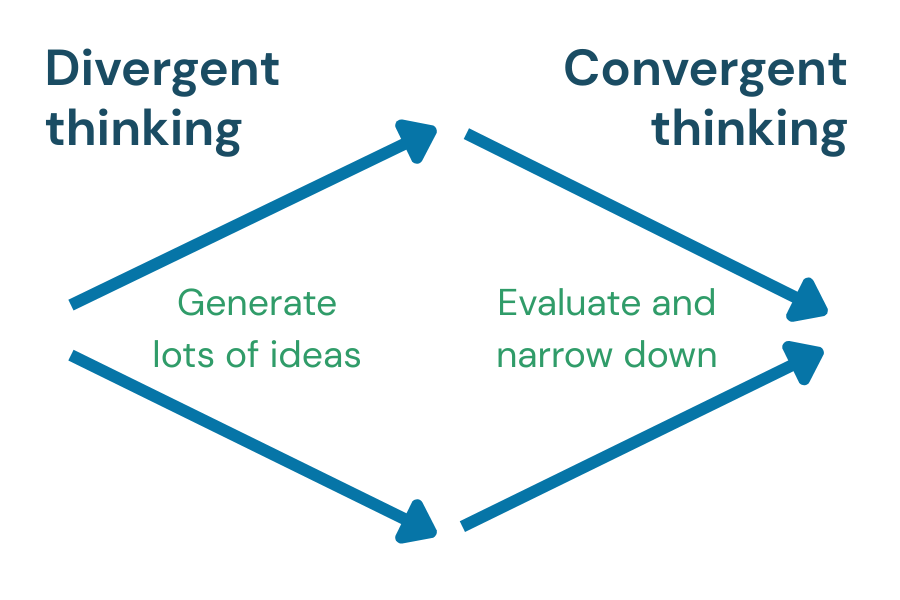
Once you have a solid list of ideas for goals, run a round of dot voting. This “convergent” part of the process will help you narrow down the initial ideas to a smaller list representing the group’s collective perspectives.
After capturing this refined list, feel free to let everyone go back about their day.
Next, compile relevant resources to feed your AI (preferably Claude or ChatGPT to take advantage of the Projects feature). Gather any documents that provide helpful context about your organization’s goals, programs, past results, etc. For instance, you might include:
- Annual reports
- Internal strategies
- Communications plans
- Analytics reports
- Monitoring, evaluation, and learning reports
Once you’ve got some relevant documents together, feed them to your AI Project.
Phase two: Refine
- Time required: 60 to 90 minutes (one or more Centaur brainstorming sessions)
- Who’s involved: You and your AI
With the insights collected in the first phase, kick off a round of iterative dialogue with your AI. The idea of this phase is to continue refining your initial ideas — pressure testing, conceiving alternatives, speculating possible outcomes, and ultimately prioritizing the top ideas.
A general principle of Centaur collaboration is to provide extensive context to your AI. The more it understands about your task and its purpose, the better the feedback it will provide.
While you will no doubt find your own rhythm to these conversations, this phase might involve a series of activities like this:
- Setting the context and constraints for the conversation
- Categorizing goals
- Brainstorming additional activities to achieve goals
- Estimating budget and resources
- Prioritizing goals and activities using frameworks like RICE, MoSCoW, etc.
To start off the conversation, you can use a prompt like this one (be sure to swap out the placeholder text):
| I’m working with my team to develop a communications roadmap that will guide our work over the next 6-12 months. We’ve just completed an internal brainstorming session where we identified promising communications goals and activities based on conversations with key stakeholders across the organization. Now I’d like to work with you to refine these ideas, pressure-test them against our organizational capacity and audience needs, and prioritize them into a cohesive roadmap. Context and constraints: * We need to be realistic about our limited capacity—we have a small team that’s already stretched thin * Every activity we include needs to clearly support our broader organizational mission and goals * We should prioritize activities that build on each other rather than creating a scattered approach * Our target audiences include [describe key audience segments] * Our organizational strengths are [describe what you do well], and our current gaps are [describe limitations] Reference materials: Please review the following for additional context: * [PROJECT FILE: organizational strategic plan or relevant planning documents] * [CHAT: stakeholder interview notes or brainstorming session summaries] * [Any relevant audience research or previous communications plans] What I’d like to accomplish first: Let’s start by organizing the brainstormed ideas into logical categories (e.g., brand building, audience engagement, thought leadership, stakeholder communications). Then I’d like you to help me identify which ideas might be redundant or could be combined, and flag any obvious gaps where we’re not addressing important audience needs or organizational priorities. I’ve attached the results of the team’s brainstorming discussion, which includes both the full set of original ideas, along with the initial prioritization through dot voting. [UPLOAD DOCUMENT WITH BRAINSTORMING RESULTS] |
Given the unpredictable nature of GenAI outputs, there’s no way of knowing exactly how this conversation unfolds from here. But you can rest assured that some juicy insights will arise.
As you work towards a promising shortlist of priorities, a good final step is to use a prioritization framework like RICE (Reach, Impact, Confidence, and Effort) or MoSCoW (Must have, Should have, Could have, Won’t have). Gathering data for either of these methods can typically be time-consuming and fraught from assumption-based thinking. However, you can accelerate the process in Centaur Mode.
Working with your AI, you can come up with quantitative and qualitative assessments of the potential for each of your goals to achieve the greatest impact.
Here’s an example prompt using the RICE framework you could use to guide this part of the conversation (don’t worry if RICE is new to you — the AI will work through each component with you step by step):
| Now that we’ve refined our list of potential communications goals, I’d like to use the RICE framework (Reach, Impact, Confidence, and Effort) to prioritize them systematically. For each goal we’ve identified, please help me assess: Reach: How many people in our target audiences will this goal affect over the next 6-12 months? Consider both direct reach (people who directly engage) and indirect reach (people who might be influenced through secondary channels). Impact: If successful, how much will this goal move us toward our organizational mission and strategic objectives? Rate on a scale where 3 = massive impact, 2 = high impact, 1 = medium impact, 0.5 = low impact. Confidence: Based on our organizational capacity, past experience, and the resources we have available, how confident are we that we can successfully execute this goal? Rate as a percentage (100% = completely confident, 80% = high confidence, 50% = medium confidence, 25% = low confidence). Effort: How much total work will this require from our team? Estimate in person-months of work (e.g., 0.5 = two weeks of one person’s time, 2 = two months of one person’s time or one month of two people’s time). For each goal, please ask me clarifying questions if you need more information to make these assessments. Push back if any of my assessments seem overly optimistic or if I’m underestimating effort based on similar projects you’ve seen discussed in our previous conversations. Then calculate a RICE score (Reach × Impact × Confidence / Effort) and rank the goals accordingly. Finally, help me sense-check whether the rankings align with our strategic intuition, and flag any goals that might be scored lower but are still critical foundational work we shouldn’t skip. |
Prioritization inevitably involves making some assumptions — whether conducted by humans or with AI. So as always, take the results of this conversation with a grain of salt and verify the outputs as possible.
Now that you have a concise list of clear priority goals, it’s time to plan implementation.
Phase 3: Plan
- Time required: 30 to 45 minutes
- Who’s involved: You and your AI
The final part of the roadmap is to bring a dose of logistical reality to the goals: planning the timeline, resource allocation, and delegation.
Your prompt at this stage might look something like this:
| Based on our RICE prioritization, let’s create a realistic implementation plan for our top-priority communications goals. I’d like to work through each goal systematically to map out the timeline, resources needed, and task assignments. For each priority goal, please help me: * Break down the work: What are the major milestones and key tasks required to achieve this goal? Help me identify any dependencies—tasks that must be completed before others can begin. * Develop a timeline: Based on our team capacity and the effort estimates we developed earlier, what’s a realistic timeline for completing this goal? Consider our other ongoing commitments and flag any potential scheduling conflicts or bottlenecks. * Identify resource needs: Beyond staff time, what other resources will we need? This might include budget for contractors or tools, access to subject matter experts, design or technical support, or approval from leadership. As we work through this, please challenge me if any timeline seems unrealistic given the scope of work, if I’m overloading any single team member, or if I’m underestimating the coordination effort required. Also flag any goals where starting later might actually be more strategic—for instance, if one goal would benefit from insights gained from completing another goal first. Let’s start with our highest-priority goal and work through the planning process together before moving to the next one. |
Naturally, you will know your context, organization, and team capabilities far better than the AI can possibly know. Most likely, you’ll take the initial responses and adjust them considerably to align with your needs. Some back-and-forth conversation with your AI can help you uncover further blind spots and opportunities for refinement.
With these draft ideas, you’re ready to delegate parts of the plan to relevant team members. As always, assigning ownership of tasks increases the likelihood of successful completion. With these inputs, you’ll have a solid roadmap you can pressure test with your leadership team and seek buy-in.
Conclusion
As with any plan, the true test comes when you put it into action. They say in the military “no plan survives first contact [with the enemy].” In the mission-driven context, we’re typically not squaring up against an enemy, but facing budget constraints, complex donor requirements, and challenges that come from the interactions between highly diverse groups of people. So even when circumstances change, you’ll have a solid foundation to build from, rather than reacting in the moment.
With this approach, we can create and refine a plan in a matter of hours, rather than days or weeks. By bringing together the lived experience and big picture vision of your leadership team with the accelerated ideation and research capabilities of AI, you can continually create and adapt the plan to achieve your goals.
Ready to try it out? Download the workflow summary resource below, activate your team, and get ready for some roadmapping: